Sir Ellis Jones Ellis-Griffith
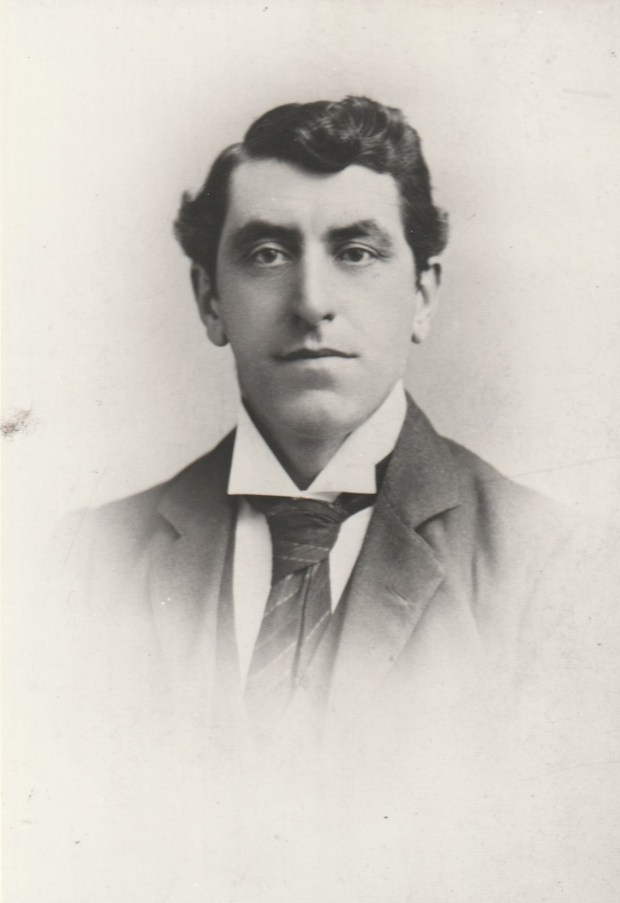
Sir Ellis Jones Ellis-Griffith, 1st Baronet, PC, KC (23 May 1860 – 30 November 1926) was a barrister and radical Liberal politician. He was born Ellis Jones Griffith.
He was the only child of Thomas Morris Griffith (1827-1901), a master builder, and his wife Jane (nee Jones) (1823-1881), and grandson of William Jones (Llyslew) and Eleanor Hughes. Both his parents were Welsh, but had been living in Birmingham at the time of his birth, before moving to Brynsiencyn when he was a child.
He was initially educated at the Holt Academy, and passed both the Cambridge and Oxford local examinations in 1873. The following year he passed a scholarship examination for the University College, Aberystwyth, where he began studying in 1876. He took an arts degree at the University of London in 1879, graduating with double honours in English and Philosophy, before moving to Downing College, Cambridge, in 1880, where he read Law and was President of the Cambridge Union.
He married Mary (1862-1941), daughter of Robert Owen, in 1892. They had two sons and one daughter. The couple’s only surviving son, Ellis, succeeded in the baronetcy after his father’s death, but died without issue in 1934.
He was called to the Bar, Middle Temple, in 1887 and worked on the North Wales and Chester Circuit. Among his most notable cases was his defence of Major Spilsbury in the Gibraltar Tourmaline smuggling case in 1898. He was a Recorder of Birkenhead from 1907 to 1912 and was appointed a King’s Counsel in 1910.
He then embarked on a career in politics, and initially stood unsuccessfully for the constituency of West Toxteth in 1892, but in 1895 was successfully returned to Parliament for Anglesey. He was returned unopposed in 1900.
Upon his appointment as Recorder of Birkenhead in 1907 he was required to re-submit himself to his electorate at Anglesey and was again returned unopposed. Whilst an MP he voted in favour of the 1908 Women’s Enfranchisement Bill. He served in the Liberal administration of H H Asquith as Under-Secretary of State for the Home Department from 1912 to 1915. In 1918 he was created a baronet, of Llanidan in the County of Anglesey, and changed his surname to Ellis-Griffith.
He was narrowly defeated at Anglesey in the 1918 General Election by the Labour candidate Owen Thomas. He then unsuccessfully contested the University of Wales constituency in 1922, before returning to the House of Commons in 1923, when he was elected for Carmarthen, but he resigned the seat the following year, citing personal unfulfilment in his parliamentary career.
In November 1926, Sir Ellis Jones Ellis-Griffith (who had previously suffered small bouts of ill health) was in Swansea, as defence in a manslaughter case at the assizes court. It was noted during the day that he appeared unwell, and after retiring to his room at the Metropole Hotel that evening, he was found by two colleagues, in great pain, on the floor. Despite receiving medical treatment, he died at the scene, aged 66. His wife, Jane, was in the Italian Riviera at the time of his death, and was brought home shortly afterwards. The cause of death was later ruled as apoplexy. He was buried at St Nidan’s Church, Llanidan on 4 December 1926.
This biography is based on an entry in Wikipedia.
 William Jones Family Archive